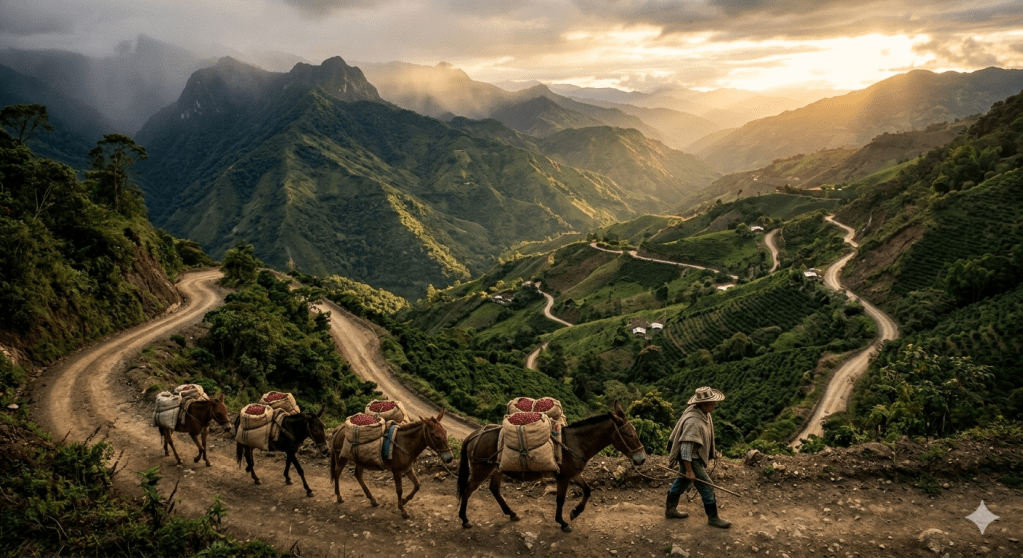
Cinematic wide shot mountainous region in Colombia, a traditional muleteer is loaded with hessian sacks overflowing with red coffee cherries.
Note. Image generated by Gemini 3.0, Google, March 02, 2026. https://gemini.google.com/share/b802e1b78a9d
When you pay a premium for a single-origin Ethiopia Yirgacheffe or a prized Geisha from Panama, you aren’t just paying for the bean. You are paying for one of the most complex, fragile, and historically fraught supply chains on the planet.
Arabica coffee (Coffea arabica) is the diva of the agricultural world. It demands high altitudes and specific climates. Most importantly, it requires impeccable handling from the moment it is picked until it lands in your roaster.
Let’s take a journey through the logistics of this global commodity, exploring how it moves from the mountainsides of the “Bean Belt” to your cup, and the historical lessons that have shaped its turbulent trade.
The Geography of the Bean
Arabica is notoriously picky. It grows best in the “Bean Belt,” the band between the Tropics of Cancer and Capricorn. The major players are split between two hemispheres, creating a logistical dance that ensures a year-round supply of green beans:
- Latin America (The Volume Players): Brazil (the world’s largest producer) and Colombia dominate the market for volume and consistency. Their proximity to the United States and European ports offers logistical advantages, primarily shipping through the Panama Canal.
- East Africa (The Birthplace): Ethiopia (the genetic origin of coffee) and Kenya produce beans with complex floral and fruity notes. Logistics here are a challenge of infrastructure, moving containers from highland regions to ports like Djibouti or Mombasa.
- Asia (The Rising Stars): Indonesia (Sumatra, Java) and increasingly Myanmar provide earthy, heavy-bodied beans. The logistics here involve navigating ancient archipelagos and monsoon seasons.
The Cold Chain: Keeping the Diva Fresh
The biggest misconception about coffee logistics is that the journey ends at the port. In reality, the journey is a race against time and the elements. Green coffee is not inert; it is a seed, alive and breathing.
Here is how the modern supply chain works to preserve quality:
- Inland Transit (The Riskiest Leg): After processing (washed, natural, or honey), the beans have a moisture content of around 10-12%. They are bagged in GrainPro bags or vacuum-packed in vacuum-sealed bags to protect them from moisture absorption and odors.
- The Challenge: In countries like Ethiopia or Colombia, the journey from the washing station to the dry mill might involve mules, motorbikes, and winding mountain roads. Exposure to humidity or heat here can degrade the bean before it even sees a shipping container.
- The Ocean Voyage: Container ships move millions of 60kg (132lb) bags annually. The container is a controlled environment, but not perfectly climate-controlled unless premium reefers are used (which is rare for standard green coffee).
- The Route: A container leaving Mombasa (Kenya) might sail through the Suez Canal, stop in the Mediterranean, and cross the Atlantic to the US East Coast. This takes 30-40 days.
- Warehousing & Roasting: Upon arrival, the coffee is “rested” in climate-controlled warehouses in the consuming country. Roasters then transform the dense, green seed into the aromatic brown bean we recognize.
Success Stories: When Logistics Built Empires
History shows that the ability to move coffee efficiently has built national identities and corporate giants.
The Brazilian “Coffee with Milk” Policy
In the early 20th century, Brazil held a virtual monopoly on the world’s coffee supply. They didn’t just grow it; they mastered the logistics of scale. They built railways specifically to funnel coffee from the São Paulo hinterlands to the port of Santos. This efficiency allowed them to flood the market, control prices (until the Great Depression crashed demand), and establish coffee as a staple of the global working class.
The Rise of Colombian Milds
Colombia faced a geographic nightmare: steep Andean slopes. Their success came from branding (“Juan Valdez”) paired with logistical innovation. They invested heavily in trucking infrastructure and regional cooperatives to ensure that high-quality “Milds” could reach ports without mixing with lower-grade beans. This logistics discipline is what allows them to command a premium to this day.
Failures and Tragedies: When the Chain Breaks
For every perfectly delivered container, there are ghosts of shipments past. The history of Arabica is littered with logistical catastrophes.
The Coffee Rust Crisis (2012-2013)
While agronomically a fungus, La Roya spread so rapidly through Central America due to a combination of weather and logistical failure.
- The Failure: Countries like Guatemala and Honduras lacked the “logistical agility” to quarantine affected areas or reroute the supply of resistant seedlings quickly. The result was a collapse in production, mass unemployment, and a wave of migration from coffee-growing regions. The logistics of information and agricultural aid failed as badly as the transport of goods.
The Container Ship “MOL Comfort” Disaster (2013)
In the high-stakes world of shipping, the loss of a vessel is catastrophic. When the MOL Comfort broke in two in the Indian Ocean, it was carrying thousands of tons of cargo, including high-value Yirgacheffe and other East African coffees.
- The Failure: Beyond the immediate loss of product (worth millions), it disrupted contracts for months. Roasters who had forward-bought those specific lots had to scramble for replacements, often at higher prices. It was a stark reminder that the entire supply chain rests on the hull of a steel ship crossing a volatile ocean.
The Pandemic Container Crunch (2020-2022)
This was a systemic failure of modern logistics. As demand for goods surged, empty containers piled up in the West instead of returning to Asia and producing countries.
- The Impact: Exporters in Kenya, Colombia, and Ethiopia couldn’t get boxes to ship their harvest. Freight rates skyrocketed by 300-500%. The just-in-time inventory model failed the coffee industry, which needs just-in-case inventory. Many smallholder farmers, who had already sold their crop forward at fixed prices, were hit with crippling demurrage and detention charges as their coffee sat at ports waiting for a vessel.
The Future: Traceability and Tech
Today, the logistics of Arabica is shifting from pure transport to “provenance transport.” Blockchain technology is being piloted to track a lot from a specific hillside in Huila, Colombia, to a roaster in Portland.
The goal is to prevent the “blending” of quality in the supply chain and ensure that the premium paid for a high-end bean actually reaches the farmer. Meanwhile, climate change is forcing logistics providers to plan for new routes and storage solutions as growing regions shift to higher altitudes.
The next time you sip that bright, acidic pour-over, remember: you aren’t just tasting cherry and chocolate notes. You are tasting the triumph of thousands of miles of transport, the narrow miss of a typhoon in the South China Sea, and the promise of a supply chain that, despite its failures, keeps the world caffeinated.
 Reelkopi Home
Leave a comment