Coffee has been around from the muddy trenches of the Civil War to the front operating bases in Afghanistan. It has been more than just a beverage for soldiers. It has been a critical military ration. It serves as a vital morale booster and an enduring symbol of comfort and camaraderie. The relationship between war and coffee is a powerful thread in modern history. It influences social habits. It drives technological innovation. It even affects geopolitics.
☕ The American Civil War: Coffee as a Strategic Advantage
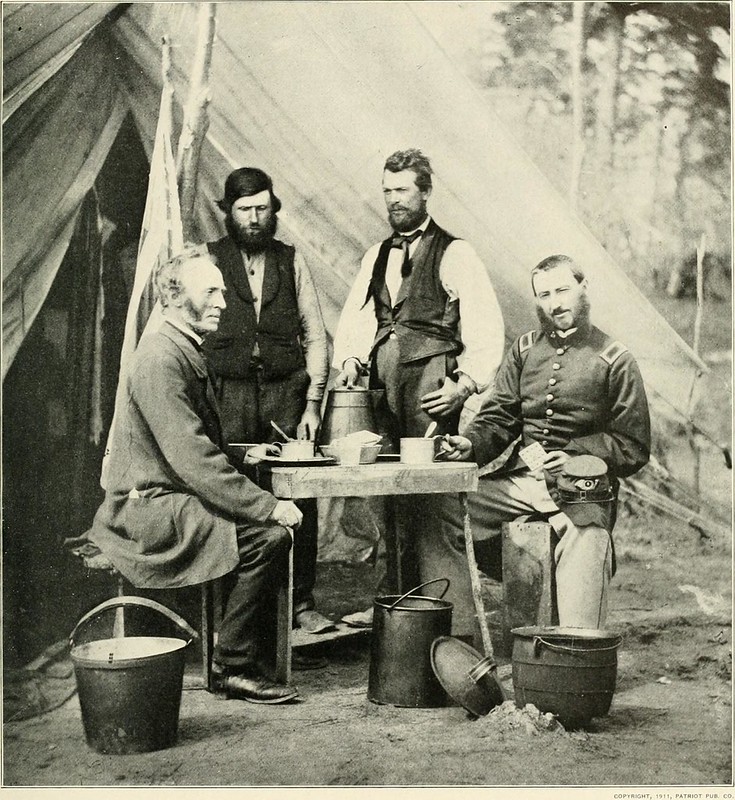
The pivotal role of coffee in warfare became unmistakably clear during the American Civil War (1861-1865). For Union soldiers, coffee was a standard issue ration, with each man receiving approximately 36 pounds per year. It was an indispensable part of a soldier’s life, consumed before marches, after battles, and during any brief respite.
The contrast between the Union and Confederate armies highlighted coffee’s strategic value. The Union blockade of Southern ports severely restricted the Confederacy’s access to coffee beans. Deprived of the real thing, Southern soldiers resorted to brewing bitter substitutes made from roasted acorns, chicory, peanuts, and peas. The deprivation was so intense. Soldiers from opposing sides would famously trade tobacco for coffee during quiet moments along the front lines.
The importance of coffee was captured in the diaries and letters of the men. Historians note that the word “coffee” appears more often in soldiers’ writings than “war,” “slavery,” or even “Lincoln”. Its significance was even enshrined in weaponry. The Sharps Rifle Company produced a carbine with a built-in coffee grinder in its stock. This allowed a soldier to store beans in a hollow compartment. They grind them and brew a cup even in the field.
🌎 World War I: Instant Coffee and the Birth of “A Cup of George”
World War I marked a turning point, transforming coffee from a campfire brew into a modern, mass-produced necessity. The U.S. War Department declared coffee as important as “beef and bread” for troop morale and effectiveness. In 1918 alone, the Quartermaster provided over 75 million pounds of coffee to nearly 3 million servicemembers overseas.
To guarantee freshness, the Army set up local roasting and grinding plants in France. They shipped the beans green to be roasted near the front. Still, the cramped, hazardous conditions of trench warfare demanded a new solution: instant coffee.
Though invented earlier, instant coffee saw its first large-scale military use in WWI. The U.S. military purchased the entire output of companies like the G. Washington Coffee Refining Co., snapping up to 37,000 pounds per day to meet demand. Soldiers stirred the soluble powder into hot water in their tin mugs. They affectionately called it “a cup of George” after the company’s founder. It was particularly crucial when mustard gas attacks made brewing coffee by traditional techniques impossible.
For the doughboys, this instant brew was a lifeline to normalcy and home. As one soldier wrote, the “hot coffee with our reliable ‘hardtack’ biscuits hit the spot.” It revived exhausted, hungry, and drowsy soldiers. The war created a generation of American coffee drinkers, who brought the habit home with them.
⚡ World War II: Rationing, “Joe,” and the Instant Coffee Revolution
World War II cemented coffee’s status as the essential military fuel. The War Department considered it a non-negotiable element of the diet. It was vital for keeping troops alert during long watches and battles. American soldiers consumed an average of 32.5 pounds per person per year. A U.S. Navy historian famously wrote that while the navy can win a war without coffee, it will succeed. Yet, it “hopes never to be forced to make the experiment”.
The massive military demand collided with a threatened supply chain. German U-boats patrolled shipping lanes, and cargo ships were commandeered for war matériel. The result was severe coffee rationing on the American home front from November 1942 to July 1943. Civilians were limited to about one pound every five weeks. This was less than a cup a day. This scarcity led to widespread use of chicory, Postum, and “double-dripping” used grounds to stretch rations.
On the front, the taste of coffee had improved. Nescafé was launched in 1938 by the Swiss company Nestlé. It offered a better-tasting instant product. This product was included in every American soldier’s emergency rations. By the war’s end, the military had purchased over one million cases, the entire annual output of Nescafé’s U.S. plant.
It was during this war that coffee earned its enduring American nickname: “a cup of Joe.” While folk etymologies abound, the term very originates from the “G.I. Joe” who was so closely identified with his daily brew.
🇰🇷 The Korean War and the Globalization of Coffee Culture
The post-World War II conflicts catalyzed the global spread of coffee culture. This is vividly illustrated in South Korea. Coffee was introduced in the late 19th century. Still, it remained a luxury for the upper class. It was consumed in Western-style establishments called dabang.
The Korean War (1950-1953) was a turning point. The massive presence of the U.S. military led to the widespread introduction of instant coffee to the Korean population. This accessible, convenient product transformed coffee from an elite symbol into a beverage for the masses. It created a nation of regular coffee drinkers.
In the decades that followed, South Korea’s coffee culture evolved dramatically, blending Western influence with local social habits. By 2015, Seoul had more coffee shops per capita than Seattle or San Francisco. The 1999 arrival of Starbucks introduced concepts like take-out and self-service, further revolutionizing the market. This journey started with a wartime introduction. It evolved into a dominant cultural staple. This shows how conflict can act as a powerful vector for cultural exchange.
☮️ Vietnam to Afghanistan: Coffee as Camaraderie and Critique
In later conflicts, coffee maintained its role as a psychological bulwark for soldiers while also taking on new, symbolic meanings.
- In the Vietnam War, coffee continued to be a daily comfort for troops in the field. Nonetheless, it also became linked to the anti-war movement. “GI coffeehouses” sprang up outside military bases. They served as safe havens where disillusioned soldiers gather, drink coffee, and openly discuss their frustrations with the war. They did this without fear of reprisal from command.
- In Afghanistan and Iraq, coffee remained a fundamental part of life on advanced operating bases. In his memoir War & Coffee, Blackhawk pilot Joshua Havill describes the sparse, self-serve coffee shop on Bagram Air Base. “The Lighthouse” was a crucial sanctuary. It provided camaraderie. It also offered respite between missions. For many veterans, the ritual of coffee-making and sharing was integral to their experience. This ritual significantly shaped their civilian lives. Some, like former Marines who founded Compass Coffee in Washington D.C., have turned their military-honed appreciation for coffee into post-service careers.
✍️ Conclusion
From the rifle-butts of the Civil War, coffee was there with the soldier. It is also found in the instant packets in a modern MRE. Its history is interwoven with the stories of technological adaptation. It includes home-front sacrifice. It reflects cultural transmission and the universal human need for comfort and connection.
Coffee in wartime is more than just a caffeine delivery system. It has served as a warm reminder of home. It is a catalyst for conversation. It provides a small, daily act of normalcy in the chaos of conflict. As one Union cavalryman succinctly put it in his diary, “Nobody can soldier without coffee.” This sentiment is echoed by generations of servicemen and women. Their history has, in many ways, been brewed one cup at a time.
 Reelkopi Home
Leave a comment